
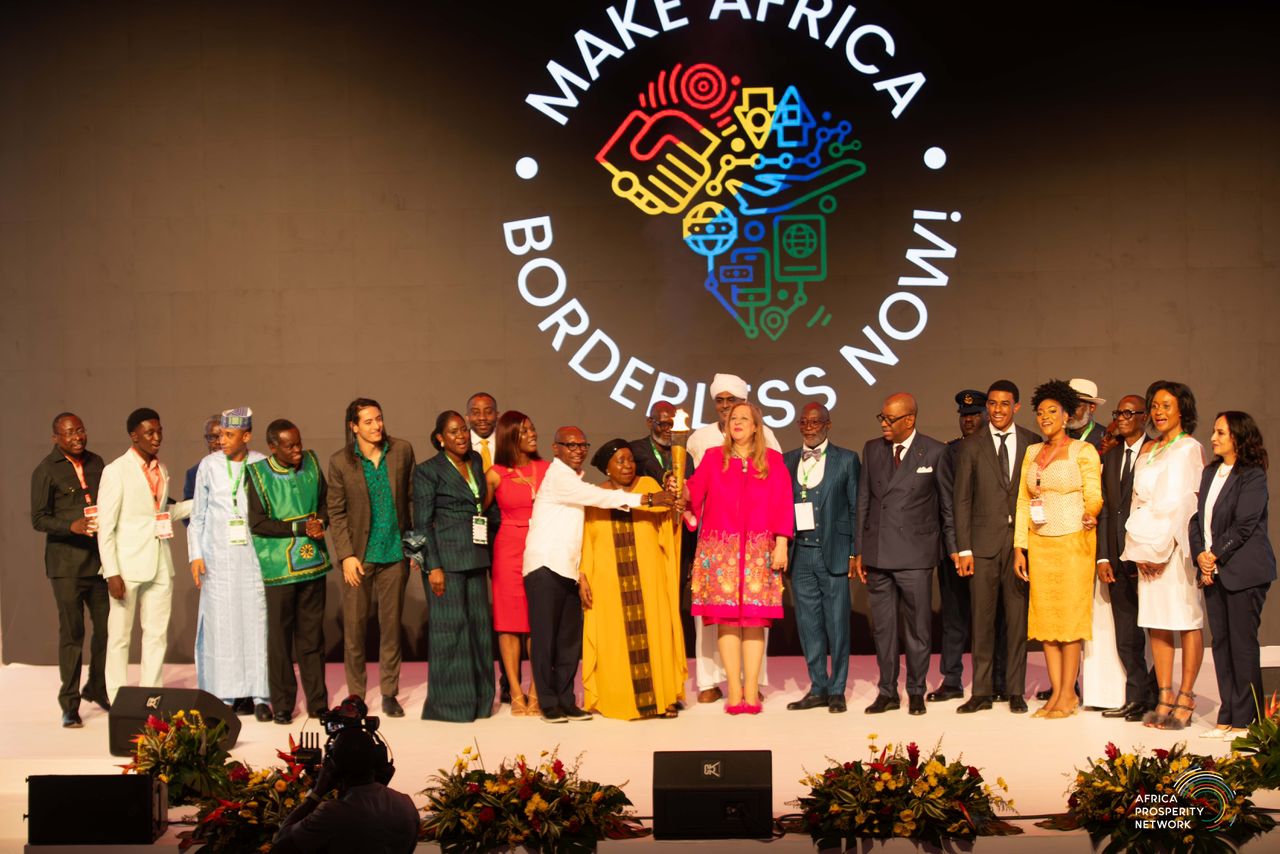
The Africa Prosperity Network (APN) has unveiled a bold 12-point Action Compact calling for the urgent implementation of Africa’s long-standing integration agenda, including visa-free travel across all African Union (AU) member states.
The Compact was adopted at the 2026 edition of the Africa Prosperity Dialogues, held from February 4 to 6 at the Accra International Conference Centre, under the theme: “Empowering SMEs, Women and Youth in Africa’s Single Market: Innovate. Collaborate. Trade.”
Described as a “People’s Compact,” the document reflects the collective position of 6,530 participants who travelled to Accra from 51 African countries and 40 others across the world.
Central to the Compact is a demand for visa-free travel for Africans within Africa. Delegates argued that without free movement of people, the vision of a truly integrated single market of 1.5 billion people will remain unattainable.
They stressed that mobility is critical to unlocking trade, innovation, and investment opportunities across borders.
The Compact also calls for seamless cross-border trade, including systems that allow Africans to buy and sell goods and services across countries using mobile money wallets.
Small and medium-sized enterprises (SMEs) emphasised that practical digital payment interoperability could significantly boost intra-African commerce, especially under the framework of the African Continental Free Trade Area (AfCFTA).
Participants agreed that Africa does not need new declarations but must fully implement existing treaties and protocols.
They cited the Abuja Treaty, the AfCFTA Agreement, the Protocol on Free Movement of Persons, and AfCFTA protocols on Digital Trade and on Women and Youth in Trade as frameworks already in place but awaiting full execution.
Although the Free Movement Protocol was adopted in 2018, only four member states have ratified it—far below the 15 required for it to enter into force.
Delegates warned that without ratification and enforcement, businesses will continue to face barriers to scaling across borders, undermining Africa’s integration efforts.
With youth unemployment described as the continent’s most urgent challenge, speakers argued that economic integration is no longer optional.
They estimated that Africa must create between 15 and 20 million jobs annually to meet growing demand and cautioned that fragmented markets are economically self-defeating for individual countries and the continent as a whole.
The Compact anchors the “Make Africa Borderless Now!” movement—a continent-wide petition campaign targeting 10 million signatures.
Organisers say the petition will be presented to the AU Assembly in February 2027, demanding swift ratification and implementation of existing agreements.
Chairperson of the APN Advisory Council, Nkosazana Dlamini-Zuma, described the Compact as the unified voice of Africa’s private sector, women, and youth.
“The tools for prosperity already exist. The time for implementation is now,” she said.
She referenced Agenda 2063, the continent’s long-term development blueprint, launched in 2013 during her tenure as Chairperson of the African Union Commission.
The 2026 Compact now places renewed pressure on African governments to move from commitments to concrete action.
Delegates maintained that meaningful integration—through open borders, digital payments, and enforceable trade rules—is essential for job creation, economic resilience, and shared prosperity across the continent.
DISCLAIMER: The Views, Comments, Opinions, Contributions and Statements made by Readers and Contributors on this platform do not necessarily represent the views or policy of Multimedia Group Limited.
DISCLAIMER: The Views, Comments, Opinions, Contributions and Statements made by Readers and Contributors on this platform do not necessarily represent the views or policy of Multimedia Group Limited.
Source link