
Food security, clean water, public health and economic growth across Africa are increasingly at risk as biodiversity comes under mounting pressure from climate change, deforestation, illegal mining and habitat destruction, one of Ghana’s leading conservation scientists has warned.
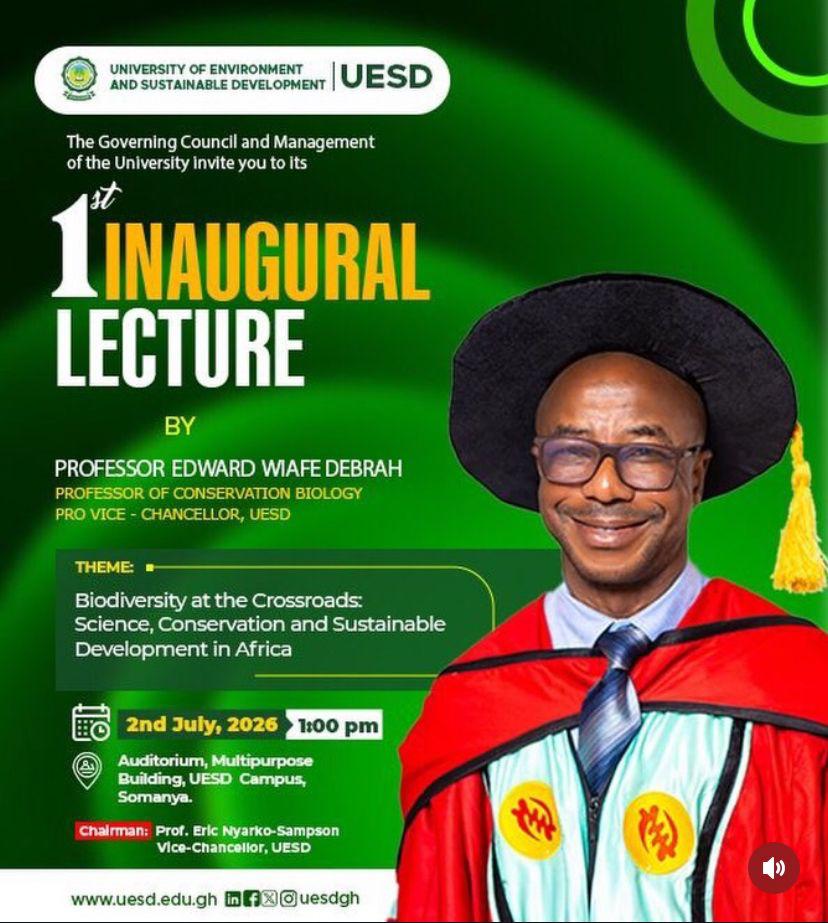
Professor Edward Wiafe Debrah made the warning while delivering his inaugural lecture as Pro Vice-Chancellor of the University of Environment and Sustainable Development (UESD) in Somanya, where he argued that protecting biodiversity should be treated as a development priority rather than simply an environmental concern.
“Biodiversity is not a luxury. It is the foundation of sustainable development. When biodiversity declines, development itself becomes more fragile,” he told academics, government officials, conservation practitioners, development partners, students and traditional leaders gathered for the lecture.
Professor Wiafe Debrah said Africa’s biodiversity faces growing threats from habitat destruction, climate change, illegal mining, deforestation, pollution, land degradation and the unsustainable exploitation of natural resources.
He argued that protecting ecosystems is essential because biodiversity supports food production, water security, climate resilience, livelihoods, tourism, public health and economic development.
The lecture, titled Biodiversity at the Crossroads: Science, Conservation and Sustainable Development in Africa, reflected on a question that has shaped much of his career:
“How can development proceed without destroying the ecological systems that sustain life,” he asked.
Drawing on more than three decades of research, he said scientific evidence must play a central role in solving environmental challenges. His work has covered primate conservation, wildlife management, forest ecology, ecosystem restoration, environmental governance and human-wildlife conflict.
Much of his research has focused on endangered primates in the Upper Guinea Forest ecosystem, including the critically endangered Roloway Monkey, Lowe’s Monkey, White-thighed Colobus and Olive Colobus. According to UESD, his research has contributed to conservation policy, IUCN Red List assessments, protected area management and international species recovery initiatives.
Professor Wiafe Debrah said conservation cannot rely solely on protected areas or law enforcement. Instead, he called for approaches that combine scientific research with community participation, environmental education, sustainable livelihoods and responsible governance.
“Conservation succeeds when science informs action, when communities are partners, and when future generations remain at the centre of our decisions,” he said.
He calls on governments, universities, communities, civil society organisations, development partners and the private sector to work together to safeguard biodiversity as the foundation for sustainable development.
DISCLAIMER: The Views, Comments, Opinions, Contributions and Statements made by Readers and Contributors on this platform do not necessarily represent the views or policy of Multimedia Group Limited.
DISCLAIMER: The Views, Comments, Opinions, Contributions and Statements made by Readers and Contributors on this platform do not necessarily represent the views or policy of Multimedia Group Limited.