
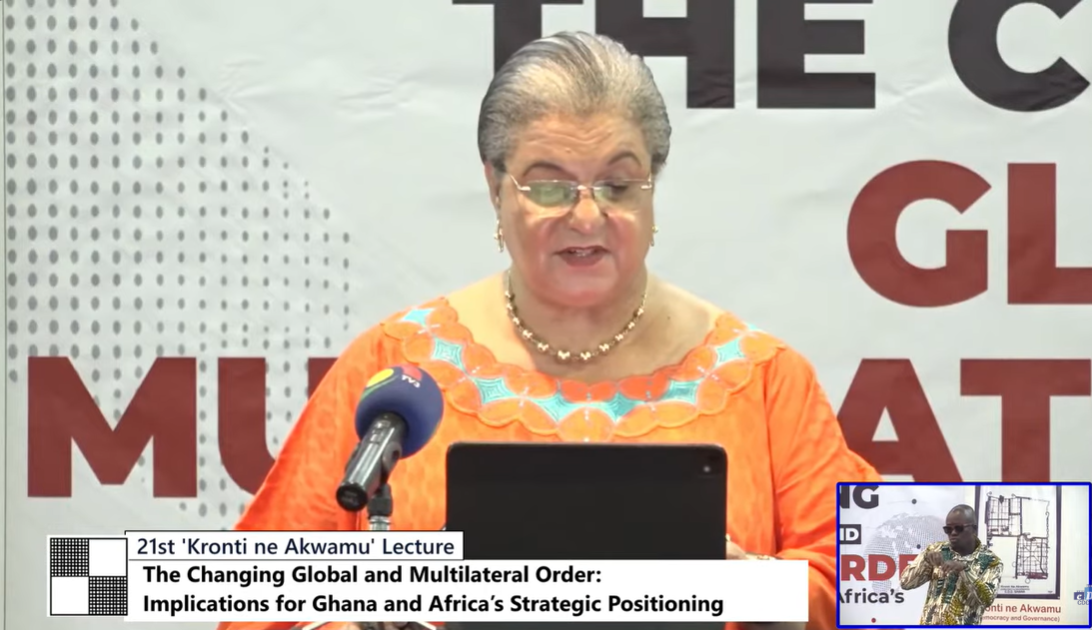
United Nations Special Representative of the Secretary-General for Libya, Hannah Tetteh, has warned that the weakening of the global multilateral system could have serious consequences for Africa, particularly countries with limited influence on the international stage.
She said recent developments threatening the foundations of the rules-based global order require collective action to preserve institutions that support peace, security and prosperity.
Speaking at the 21st Kronti ne Akwamu Public Lecture by CDD on the theme, “The changing global and multilateral-based order: Implications for Ghana and Africa’s strategic positioning,” Mrs Tetteh said the decline of multilateral cooperation would disproportionately affect smaller and less powerful nations.
“If the multilateral system continues to fracture and deteriorate, it will be to the detriment of countries with less power and influence on the global stage,” she said.
She stressed that sustaining effective multilateral institutions remains in the collective interest of United Nations member states, particularly those seeking stability and equitable representation in global affairs.
The former Ghanaian Foreign Minister explained that the multilateral system, established through the United Nations Charter in 1945, was designed around the principle that global challenges require collective responses.
She noted that institutions such as the United Nations, the African Union and regional bodies including ECOWAS have evolved to address challenges that transcend national borders.
Quoting former UN Secretary-General Kofi Annan, Mrs Tetteh said: “The challenges of our age are problems without passports,” adding that addressing such issues requires cooperation beyond national boundaries.
She identified several global challenges that continue to test the multilateral system, including climate change, digital disruption, economic inequality and rising conflicts.
Referencing UN Secretary-General António Guterres’ description of the world as facing a “five-alarm global crisis,” Mrs Tetteh said many of the challenges identified years ago remain unresolved.
She highlighted concerns over the global financial system, climate emergencies, digital risks including misinformation and cybercrime, and increasing geopolitical tensions.
Mrs Tetteh said the growing number of conflicts worldwide demonstrates the urgent need for countries to manage geopolitical divisions and strengthen mechanisms that prevent escalation.
She pointed to the adoption of the UN Pact for the Future in 2024 as part of efforts by member states to respond to emerging global challenges.
However, she cautioned that when powerful nations disregard international rules and act in ways perceived as coercive by smaller states, it weakens confidence in the global system.
According to her, the return of great power competition places additional pressure on countries such as those in Africa, which often lack the capacity to act independently on global challenges.
Mrs Tetteh said Africa must continue to engage strategically within international institutions while advocating reforms that better reflect the interests and aspirations of the continent.
DISCLAIMER: The Views, Comments, Opinions, Contributions and Statements made by Readers and Contributors on this platform do not necessarily represent the views or policy of Multimedia Group Limited.
DISCLAIMER: The Views, Comments, Opinions, Contributions and Statements made by Readers and Contributors on this platform do not necessarily represent the views or policy of Multimedia Group Limited.
Source link