
Morocco has unveiled a defence industry roadmap targeting approximately 50,000 direct and indirect jobs by 2035, as it seeks to expand local manufacturing and build an export-driven sector.
The strategy aims to meet about 40% of the Royal Armed Forces’ and security agencies’ equipment requirements. It also targets exports accounting for more than 65% of the sector’s turnover.
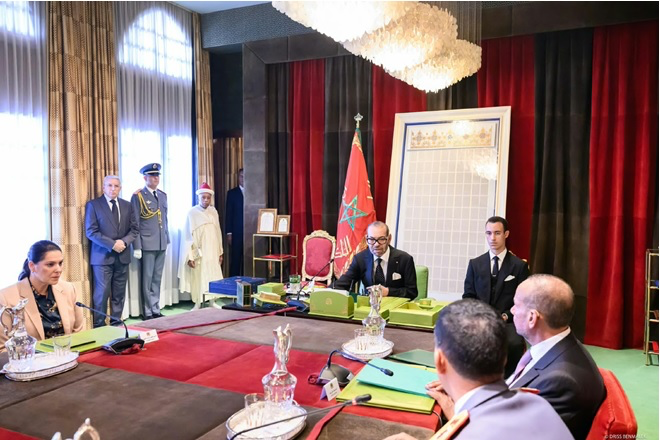
King Mohammed VI, accompanied by Crown Prince Moulay El Hassan, chaired a working session at the Royal Palace in Rabat on Wednesday, November 18, to present the “Morocco Offer” and the roadmap.
The initiative seeks to strengthen Morocco’s industrial and technological independence while attracting investment, developing skills and supporting technology transfer.
It envisages an integrated industry covering research, design, manufacturing, maintenance, testing and storage. The strategy will draw on expertise developed in Morocco’s aerospace, automotive and electronics sectors.
Four institutional and industrial measures will underpin the programme.
A dedicated strategic agency will coordinate the national defence industry strategy. An industrial holding company will serve as the state’s investment arm, helping to develop local businesses and mobilise public and private capital.
A specialised academy will support training, research and innovation.
The state will also establish two additional industrial acceleration zones in Ben Guerir and Benslimane, complementing those already launched in Sidi Yahya and Nouaceur.
The roadmap builds on measures introduced following the adoption of Law No. 10.20 in 2020, which provided a legal framework for the defence and security equipment industry.
Projects launched under that framework include manufacturing WHAP 8×8 armoured vehicles in Berrechid and 30 mm gun turrets at the Midparc industrial zone in Nouaceur.
Other projects cover medium- and large-calibre ammunition production in Sidi Yahya, military drone manufacturing and maintenance in Benslimane, and autonomous systems and counter-drone technologies.
The new roadmap prioritises drones, autonomous systems, land and naval systems, defence electronics, cyber defence, and artificial intelligence.
Training will be central to the programme. The proposed academy will work with industrial operators, civilian and military professionals, and Moroccan specialists abroad to develop local expertise.
The strategy also includes identifying young talent and strengthening vocational training to supply the industry with qualified workers.
Morocco intends to use international partnerships to expand access to global supply chains and export markets. It will also encourage private investment and support domestic companies seeking to compete internationally.
At the close of the session, King Mohammed VI called for rapid implementation of the roadmap.
His instructions covered establishing governance bodies, preparing a financing plan, simplifying investment procedures, and increasing participation by the national private sector.
DISCLAIMER: The Views, Comments, Opinions, Contributions and Statements made by Readers and Contributors on this platform do not necessarily represent the views or policy of Multimedia Group Limited.
DISCLAIMER: The Views, Comments, Opinions, Contributions and Statements made by Readers and Contributors on this platform do not necessarily represent the views or policy of Multimedia Group Limited.
Source link