
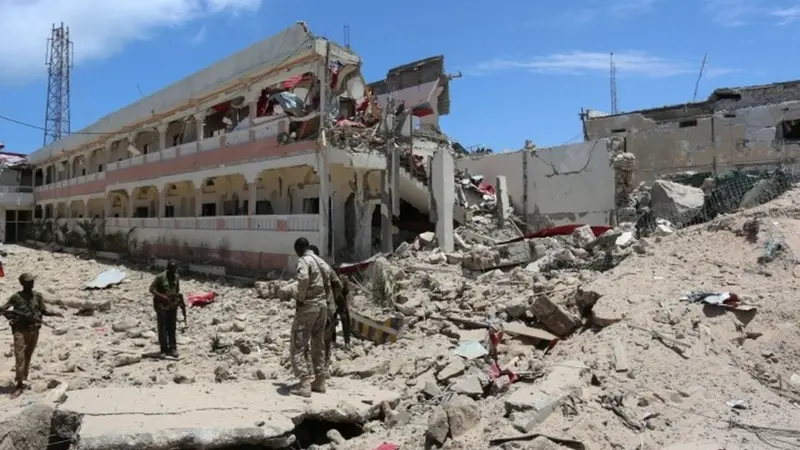
Somalia has entered a crossroads marked by fragile security, fractured politics, dwindling external support, and a painful reality in which the terrorist movement Al-Shabaab poses a formidable threat. For 18 years, the group has waged war against the federal government. Yet the federal authorities in Mogadishu remain preoccupied with persistent disputes among Somali politicians, most recently over elections scheduled for May.
A report by the International Crisis Group concludes that “it is unlikely Somalia’s elections will be held on time, and if delays persist, violence could erupt,” particularly as external support for combating Al-Shabaab comes under mounting pressure, with traditional security partners growing increasingly impatient with Mogadishu.
According to the report, “under the presidency of Hassan Sheikh Mohamud, Somalia is being drawn into regional rivalries, creating the potential for further destabilizing proxy competition.”
Brutal Incidents
In an assessment of Somalia’s security landscape between 2020 and 2025, the Hiraal Institute states that “more than 8,000 documented incidents were recorded,” pointing to “a tactical evolution by Al-Shabaab following the government offensive in May 2022—the year Hassan Sheikh Mohamud assumed office—the emergence of ISIS, Puntland’s independent military campaign against the group, and internal security challenges, including misconduct by security forces and clan violence.”
In its report published last December, the institute notes that “Al-Shabaab’s monthly attacks increased by 70 percent after the launch of security operations in May 2022, shifting from urban terrorism to rural insurgency. Targeting of civilians rose by 306 percent, while attacks on Somali army special forces increased by 1,764 percent.”
Notably, “political disputes between the federal government and regional states—particularly Puntland and Jubaland—diverted military resources away from counterterrorism missions.
Al-Shabaab’s 2025 counteroffensive reversed nearly all territorial gains and recaptured several towns.”
These political disputes revolve around President Hassan Sheikh Mohamud’s insistence on holding the anticipated May elections under a direct “one person, one vote” system, while Puntland and Jubaland adhere to the indirect electoral model based on clan representation that has been in place since 2000.
The institute’s report further observes that “Puntland’s military operation against ISIS demonstrates that effective counterterrorism remains possible when political will exists and resources are directed toward genuine threats.” The campaign reportedly carried out 364 operations against ISIS positions in the Al-Miskaad mountains, supported by Emirati and American airstrikes.
Yet a troubling indicator identified by the institute is the sharp escalation in internal security challenges: “incidents of brutality by security forces increased fourteenfold, and clan violence averaged more than 30 incidents per month in 2025.”
These indicators recall an assessment contained in a United Nations Security Council report published last October, which referenced “clashes between Jubaland forces and Somali federal forces in Beled Hawo, Gedo region, following the arrival of Abdirashid Janan, the newly appointed regional intelligence chief by the federal government and a known opponent of Jubaland President Ahmed Madobe. The clashes, which began on 22 July, continued intermittently until 11 August.”
The Global Conflict Tracker of the Council on Foreign Relations describes Al-Shabaab as “one of the strongest and most successful affiliates of Al-Qaeda,” noting that the organization continues to exploit the Somali government’s limited capacity and the country’s acute humanitarian crisis to launch indiscriminate attacks against government forces, foreign peacekeepers, and civilians.
It adds that the group’s objectives are “to destroy the Federal Government of Somalia and establish a Greater Somalia uniting all ethnic Somalis in East Africa under strict Islamist rule.”
Political Fragmentation
In a further indication of the failure of Sheikh Mohamud’s policies, the International Crisis Group affirms that “during 2025, Al-Shabaab launched attacks and recaptured vast areas of central and southern Somalia that the government had controlled since 2023.”
One of the principal drivers of the current security crisis, the group’s report argues, is “political division—between the center and the periphery, and among Somali politicians themselves—which obstructs any coherent effort to develop the security sector and other effective institutions. At present, Puntland and Jubaland, two of the country’s strongest federal states, have effectively withdrawn from the federal system.”
Meanwhile, President Sheikh Mohamud has sought constitutional amendments, including shifting from indirect elections to universal suffrage—moves many of his opponents regard as attempts to bolster his re-election prospects.
“In the absence of agreement with the opposition, he will most likely be forced to postpone the elections,” the report continues.
“If the government proceeds without broader public support, Somalia’s political fragmentation will deepen. More concerning still is the possibility that, as the government’s term approaches its end in May 2026 without a clear succession plan, opponents may mobilize supporters to pressure Mogadishu, potentially leading to violent clashes between government and opposition forces. Beyond the costs of internal political conflict, support for Somalia’s fight against Al-Shabaab could soon diminish.”
These circumstances coincide with an announcement by the World Food Programme that life-saving food assistance in Somalia may halt by next April unless new funding is secured, placing millions at risk of worsening hunger.
An estimated 4.4 million people face acute food insecurity, nearly one million of whom suffer from severe hunger, driven by failed rainy seasons, conflict, and declining humanitarian funding.
“The situation is deteriorating at an alarming pace. Families have lost everything, and many are on the brink,” said Ross Smith, Director of Emergency Preparedness and Response at the programme.
Somalia declared a national state of emergency due to drought in November 2025 following repeated seasons of insufficient rainfall, with other countries in the region likewise affected.
DISCLAIMER: The Views, Comments, Opinions, Contributions and Statements made by Readers and Contributors on this platform do not necessarily represent the views or policy of Multimedia Group Limited.
DISCLAIMER: The Views, Comments, Opinions, Contributions and Statements made by Readers and Contributors on this platform do not necessarily represent the views or policy of Multimedia Group Limited.
Source link