For the first time in five years, Ghana’s air is getting cleaner.
The IQAir 2025 World Air Quality Report, which tracks fine particle pollution, known as PM2.5, across 143 countries, territories and regions, recorded Ghana’s national annual average at 21.3 micrograms per cubic metre (µg/m³). That is the country’s lowest reading since IQAir began consistently tracking it, and a sharp reversal from 2024’s figure of 35.8 µg/m³, a drop of more than 40% in a single year.
The improvement moves Ghana from 8th most polluted country in Africa in 2024 to 11th in 2025, its best continental ranking in five years.
It is encouraging news. But it comes with a critical caveat: 21.3 µg/m³ is still more than four times the World Health Organisation’s annual safe limit of 5 µg/m³. The air most Ghanaians breathe every day remains, by global health standards, unsafe.
The trajectory of Ghana’s air quality over the past five years tells two distinct stories. The first is one of steady, worsening pollution. From 25.9 µg/m³ in 2021, Ghana’s annual average climbed to 30.2 in 2022, then 33.2 in 2023, and reached a five-year peak of 35.8 µg/m³ in 2024, a 38% deterioration over just four years that pushed Ghana to 8th most polluted on the continent.
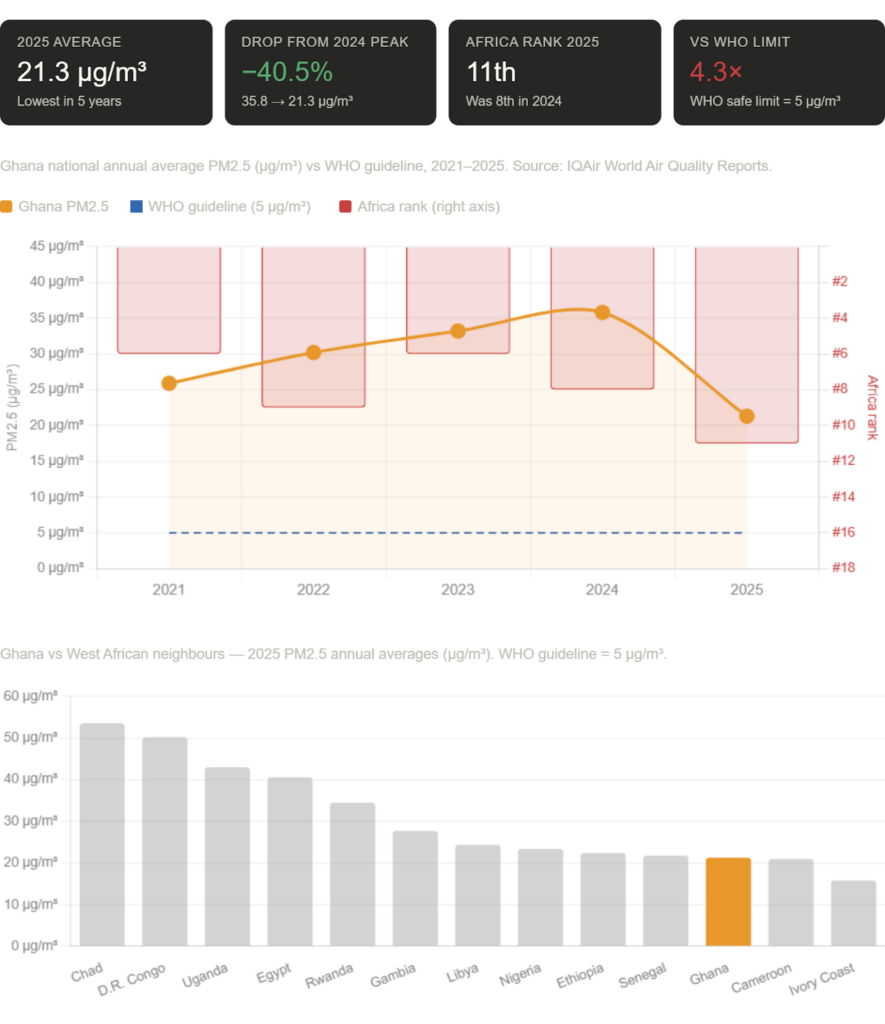
The second story, the one that matters more right now, begins in 2025. Ghana’s annual average fell by more than 14 µg/m³ in a single year, one of the most significant single-year improvements recorded for any country in the African section of the 2025 report.
What drove the drop? The IQAir report does not offer a single definitive explanation for individual country changes. But the timing points to several converging factors: the passage of Ghana’s first comprehensive Air Quality Management Regulation in September 2025, which introduced mandatory emissions reporting and a centralised data system; an expanding network of low-cost sensors under the Breathe Accra initiative that is changing how pollution is measured and reported; and the possible influence of shifting seasonal and meteorological conditions. Analysts and researchers have also noted that 2024’s figure of 35.8 µg/m³ may have been inflated by an exceptionally dry and dusty harmattan season.
One detail buried in the 2024 IQAir data, which provides city-level context for the 2025 national figures, deserves particular attention. In 2024, Kumasi surpassed Accra as Ghana’s most polluted city, registering 39.5 µg/m³, while Accra recorded 36.3 µg/m³, making it the 16th most polluted capital city globally that year.
How Ghana Compares to Its Neighbours
Ghana’s 2025 reading of 21.3 µg/m³ places it in the middle of a tight cluster of West African nations. Senegal recorded 21.8 µg/m³, just half a microgram above Ghana, while Cameroon came in at 21.0 µg/m³, fractionally below. Nigeria, one of West Africa’s most populous nations, recorded 23.4 µg/m³, and Ivory Coast recorded 15.8 µg/m³, the cleanest in the West African subregion and more than 5 µg/m³ below Ghana.
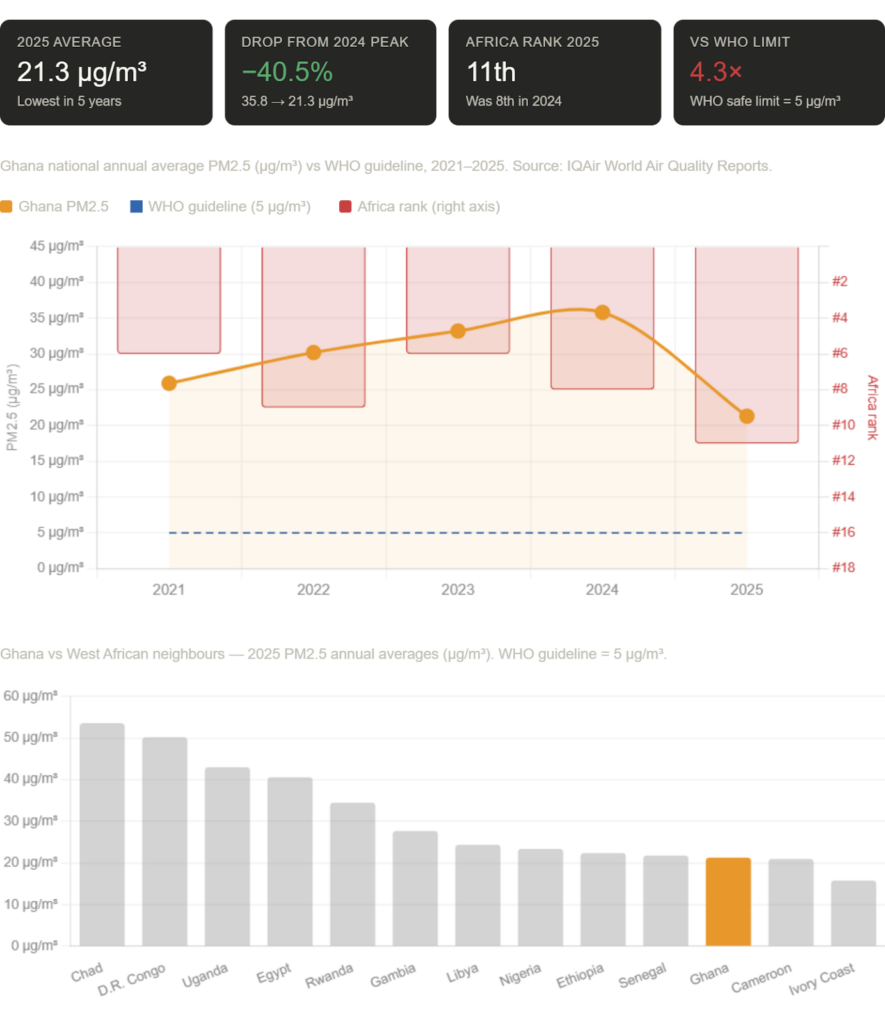
To Ghana’s north, the picture is considerably worse. Chad’s 53.6 µg/m³ and D.R. Congo’s 50.2 µg/m³ remain the two highest readings on the continent. But those numbers should be read carefully: IQAir notes that the cessation of public reporting from US Embassy monitoring stations in March 2025 removed a critical data source for several countries, and that some apparent improvements in Central Africa may reflect missing data rather than cleaner air.
For Ghana, where monitoring infrastructure has been steadily expanding, including three reference-grade monitors and a network of 60 low-cost sensors under the Breathe Accra initiative, the 2025 data is considered comparatively reliable.
The Health Stakes: What 21.3 µg/m³ Still Means
Ghana’s improvement is real. But 21.3 µg/m³ is not a safe number. It is a number that kills people, slowly and steadily, every single day.
WHO estimates suggest that 28,000 deaths occur in Ghana each year due to air pollution, roughly one death every 19 minutes, or 2,333 lives per month. In 2019, air pollution-related deaths in Ghana exceeded those from malaria, tuberculosis and HIV/AIDS combined. Research shows that meeting WHO air quality guideline values could prevent 1,790 deaths annually in Greater Accra alone, corresponding to an estimated health economic saving of approximately $247 million.
The cost of inaction compounds over time. The cumulative impact of implementing clean air interventions between 2023 and 2040 could save Accra approximately $216 million, about 20% of the Ghanaian government’s total health budget in 2022.
Children are especially vulnerable. PM2.5 particles are small enough to pass through the lungs into the bloodstream, affecting brain development, lung function and long-term cardiovascular health. In communities where charcoal cooking fires burn indoors and tro-tros idle in traffic outside schools, the exposure is daily and cumulative.
Ghana’s Air Quality Management Regulation, passed in 2025, was singled out in the IQAir report as a legal model for the African continent. It introduces mandatory reporting requirements and a centralised data system, tools that, if properly enforced, could fundamentally change how government, industry and communities respond to pollution.
Ghana is one of only seven African countries with real-time air pollution monitors. That is a meaningful advantage on a continent where 12 countries still rely exclusively on low-cost sensors and where, as the report notes, Africa’s 463 monitoring stations account for just 1% of the global total. Having the data to see the problem is the prerequisite for solving it.
But regulation and monitoring are only the beginning. A long-term policy scenario modelling a significant shift from private cars to efficient public transport, walking and cycling in Accra was estimated to avert up to 5,500 premature deaths from improved air quality, with an overall health economic saving of $15 billion over 35 years.
This story was a collaboration with New Narratives. Funding was provided by the Clean Air Fund which had no say in the story’s content.
DISCLAIMER: The Views, Comments, Opinions, Contributions and Statements made by Readers and Contributors on this platform do not necessarily represent the views or policy of Multimedia Group Limited.
DISCLAIMER: The Views, Comments, Opinions, Contributions and Statements made by Readers and Contributors on this platform do not necessarily represent the views or policy of Multimedia Group Limited.
Source link