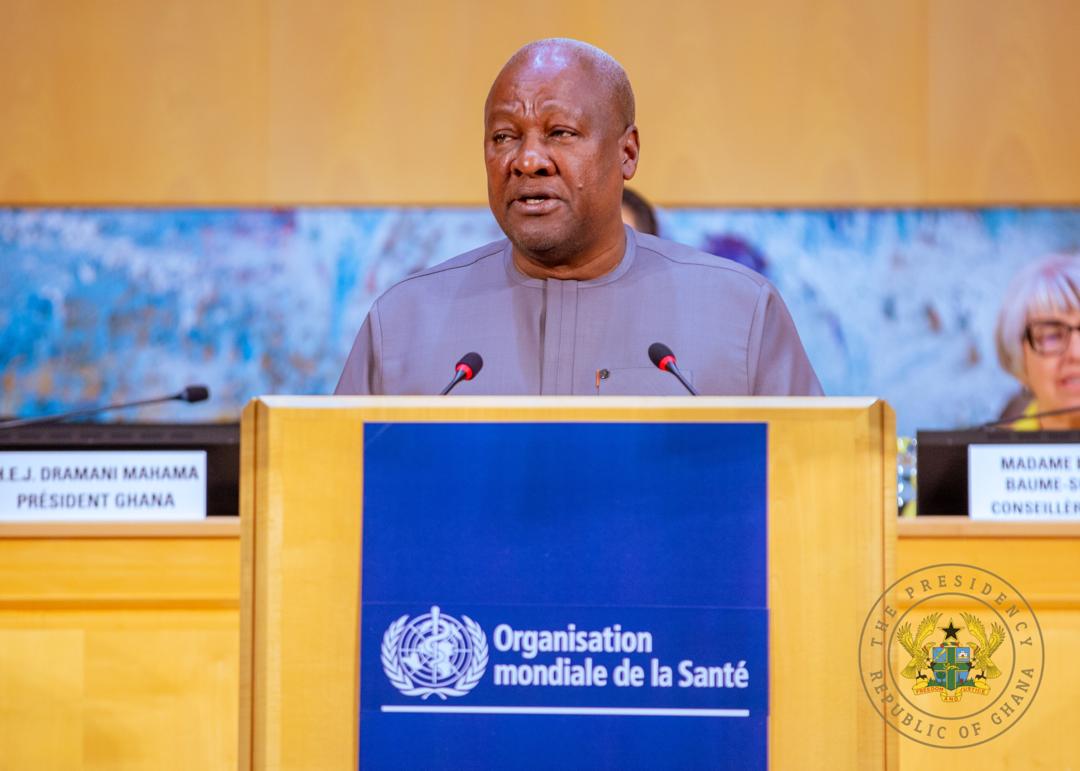
President John Dramani Mahama has used the platform of the 79th World Health Assembly to call for a major overhaul of the global health financing system, warning that Africa can no longer depend on what he described as an outdated model of donor dependency.
Addressing delegates in Geneva on Monday, Mr Mahama said sweeping cuts to international aid and the withdrawal of major Western funding from global health programmes had exposed the vulnerability of African health systems and made “health sovereignty” an urgent necessity rather than a political slogan.
“We are witnessing the end of an era, and we must have the courage to build the next one,” he declared.
In one of the strongest criticisms yet of the current global health order by an African leader, President Mahama argued that the existing system had become fragmented, overly bureaucratic, and incapable of responding effectively to modern crises.
“We do not come to Geneva to mourn the past. We come to build a future where a country’s health is not a byproduct of charity, but a result of sovereign capability,” he told the Assembly.
The President disclosed that Ghana lost approximately $78 million following the closure of USAID programmes in 2025.
He warned that similar aid cuts across Africa were already having severe consequences, citing South Africa, where the withdrawal of PEPFAR funding reportedly disrupted HIV treatment services and gender-based violence programmes.
President Mahama painted a grim picture of the future if reforms are delayed, referring to estimates that nine million preventable deaths could occur globally by 2030 as a result of shrinking humanitarian assistance and declining overseas development support.
However, he insisted that Africa must respond with structural reforms rather than despair.
“It is this gloomy outlook for the future of global health that prompted the convening of the African Health Sovereignty Conference, famously known as the Accra Reset,” he said.
The President also positioned Ghana as a leading advocate of the emerging “health sovereignty” movement, arguing that African countries must build the capacity to finance healthcare independently, manufacture medicines locally, and reduce dependence on external donors.
“A continent that manufactures less than one per cent of its vaccines while carrying twenty-five per cent of the global disease burden is not sovereign; it is vulnerable,” he stressed.
Mr Mahama outlined several domestic health initiatives aimed at advancing that vision, including Ghana’s Free Primary Healthcare Programme, reforms to the National Health Insurance Scheme, and the launch of the Ghana Medical Trust Fund, also known as MahamaCares, to support patients living with non-communicable diseases.
According to him, NHIS coverage reached an estimated 66 per cent by the end of 2025, while the removal of the cap on the National Health Insurance Fund unlocked an additional GH¢3 billion for healthcare investment.
President Mahama further disclosed that Ghana’s 2026 budget had committed GH¢34 billion to health expenditure and expanded healthcare coverage to 20 million people.
He urged global leaders to prioritise practical investments over declarations and conference statements.
“The world does not need more communiqués; it needs deal rooms, local factories, and resilient supply chains,” he said.
He concluded his address with a call for greater equity in global healthcare outcomes.
“The only metric that matters is whether a child in the Global South has a reasonable chance of survival as a child in the Global North.”
DISCLAIMER: The Views, Comments, Opinions, Contributions and Statements made by Readers and Contributors on this platform do not necessarily represent the views or policy of Multimedia Group Limited.
DISCLAIMER: The Views, Comments, Opinions, Contributions and Statements made by Readers and Contributors on this platform do not necessarily represent the views or policy of Multimedia Group Limited.
Source link