For years, air pollution work across Africa was driven by small pockets of researchers, government agencies, civil society organisations and campaigners, often working independently with little knowledge of similar efforts happening beyond their own countries.
Today, that is beginning to change.
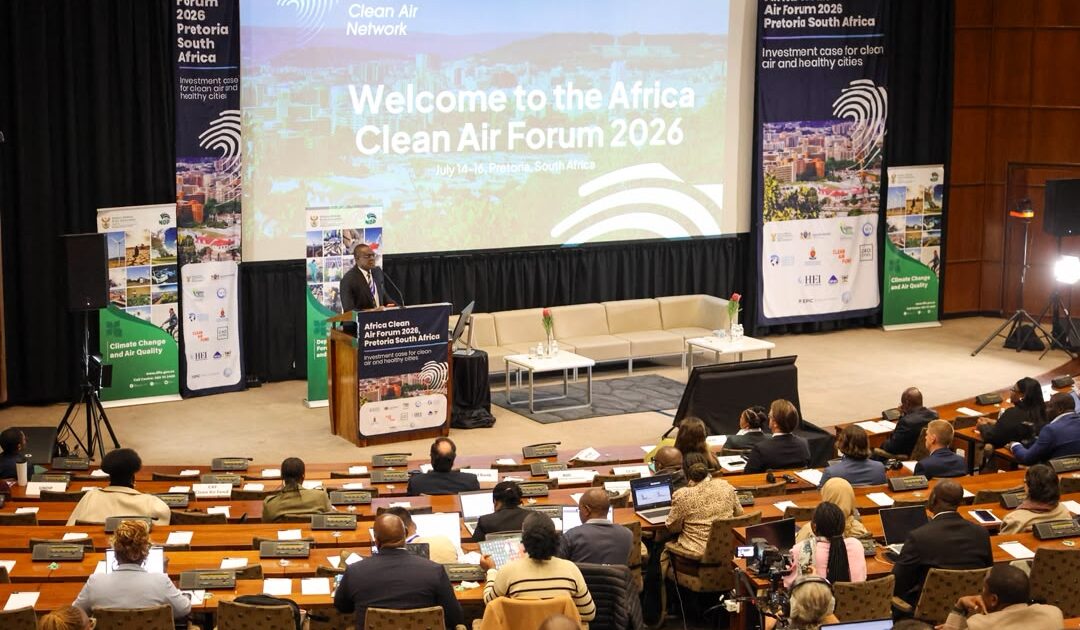
Speaking to Michael Asharley on Clean Air Report Ghana during the Africa Clean Air Forum in Pretoria, South Africa, leaders of the Africa Clean Air Network (AfriCAN) said the continent is building an unprecedented community of institutions working together to improve air quality, strengthen research and accelerate policy action.
The network, which now brings together more than 80 institutions from across Africa and beyond, was established to connect organisations that had long been tackling air pollution separately.
Head of Research and Global Partnerships at AIRQo and AfriCAN co-facilitator, Deo Okure, said air quality remains a relatively young field across much of Africa, but interest has grown significantly over the past decade.
“Air quality work in general is a relatively new area in the region, both in terms of policy work and research and all the things that need to happen for us to secure a clean air future,” he said.
According to Okure, governments, universities, development organisations and researchers had all been making progress, but opportunities to collaborate across countries and sectors were limited.
“Over the years, there have been several groups trying to do work and doing lots of amazing things on the continent. One thing that really stood out is the fact that while this was happening, a lot of this work was actually happening in silos. We did not have a dedicated platform to allow us to collaborate better within the continent or share experiences and ideas.”
He said the network was created to bridge those gaps.
“That is how the network was born… to give us that shared platform to enable collaborations across borders, across disciplines and across sectors for clean air action in the region.”
The annual Africa Clean Air Forum has since become one of the network’s biggest platforms for bringing that collaboration to life.
This year’s gathering in Pretoria attracted hundreds of participants, including scientists, government officials, healthcare professionals, engineers, urban planners, journalists, funders and environmental advocates from across the continent.
For many attendees, the forum demonstrated just how rapidly Africa’s clean air community is growing.
Head of Global Initiatives at the Health Effects Institute and AfriCAN co-facilitator, Dr. Pallavi Pant, said the diversity of organisations within the network is one of its greatest strengths.
“At the moment, we have over 80 institutions from within Africa and also outside Africa that are partners,” she said.
Those members include environmental protection agencies, universities, research organisations, civil society groups, private companies, communications organisations and international partners working across the science and policy spectrum.
Dr. Pant said the network is helping organisations realise they are no longer working alone.
“There’s actually lots of people coming from many different sectors and disciplines and countries and cities that are working on air quality together. The forum, in particular, becomes a place for them to exchange ideas, establish new collaborations and learn from one another.”
Membership remains open to institutions working on air quality across Africa, regardless of their size, and there are no membership fees.
Applicants are simply required to demonstrate how their work contributes to improving air quality and aligns with the network’s objectives.
While collaboration has become the network’s foundation, its ambitions extend far beyond bringing organisations together.
One of its biggest priorities over the next five years is expanding air quality monitoring across Africa.
Many cities still have little or no routine monitoring, making it difficult for governments to understand the scale of pollution or measure progress.
“Many cities are yet to see their first data point,” Okure said.
“We hope that in the next five years, maybe at least every city in the African region has at least one data point. We believe that is possible if we work together.”
The network is also encouraging more governments to adopt national air quality standards.
According to Okure, almost half of African countries are yet to establish explicit air quality standards, despite growing evidence linking polluted air to respiratory disease, cardiovascular illness and premature deaths.
“If at least 80 percent of all the countries in the region have air quality standards, we think that will be an important milestone and a strong foundation to advance action.”
This year’s Africa Clean Air Forum focused heavily on another challenge confronting the sector: financing.
Held under the theme “The Investment Case for Clean Air and Healthy Cities,” discussions centred on how governments and organisations can sustain clean air programmes at a time when international donor funding is becoming increasingly uncertain.
Dr. Pant said the forum reflected the growing maturity of Africa’s clean air movement.
“There is recognition that we need to act on air pollution. We also know there’s increasingly a very strong case for clean air action, including the health benefits and the productivity benefits that we can see. But one challenge that consistently gets talked about is the fact that we need money to do a lot of the work that we would like to do.”
Participants explored opportunities to access climate finance, develop public-private partnerships and attract new investment for air quality programmes.
For Okure, the conversation marked an important shift in how governments and development partners view air pollution.
“Air quality work is not just a research problem. We need to actually put money into action. We need to talk about how we can invest in the different initiatives and where this money needs to come from.”
Beyond financing, both experts believe stronger partnerships will ultimately determine whether Africa succeeds in tackling air pollution.
Dr. Pant said solutions cannot come from one ministry or one sector alone.
“We need to work across our silos. We need to find allies in city planning, urban planning, meteorological departments, the health sector and community health workers. Building those stronger coalitions will help us implement solutions that perhaps are not the first things that come to mind when we think about air quality action.”
Okure also urged the clean air community to place greater emphasis on success stories rather than focusing solely on challenges.
“One thing we could do better is approach the problem more positively by focusing on the big wins and using those to identify the low-hanging fruits that we can build on to make the case for more action.”
Looking ahead, the Africa Clean Air Network plans to expand fellowships for early-career researchers, strengthen policy engagement, continue its monthly knowledge-sharing webinars and build on the momentum generated in Pretoria.
Although organisers are yet to announce the host city for next year’s Africa Clean Air Forum, they confirmed it will take place in July 2027 in a different African country.
Dr. Pant also encouraged greater participation from journalists, saying the media has an important role in helping communities understand air pollution and highlighting the solutions already emerging across the continent.
“We want to encourage more people from the media community to engage because there’s a lot that we can learn from what you all do. You can also help us spread the amazing work that cities, researchers and community members are doing across Africa on clean air.”
As the forum concluded, one message resonated throughout the discussions in Pretoria: Africa’s clean air movement is no longer defined by isolated projects. It is increasingly becoming a connected community working across borders, disciplines and sectors to confront one of the continent’s most pressing public health challenges.
This story was a collaboration with New Narratives. Funding was provided by the Clean Air Fund which had no say in the story’s content.
END.
DISCLAIMER: The Views, Comments, Opinions, Contributions and Statements made by Readers and Contributors on this platform do not necessarily represent the views or policy of Multimedia Group Limited.
DISCLAIMER: The Views, Comments, Opinions, Contributions and Statements made by Readers and Contributors on this platform do not necessarily represent the views or policy of Multimedia Group Limited.
Source link