
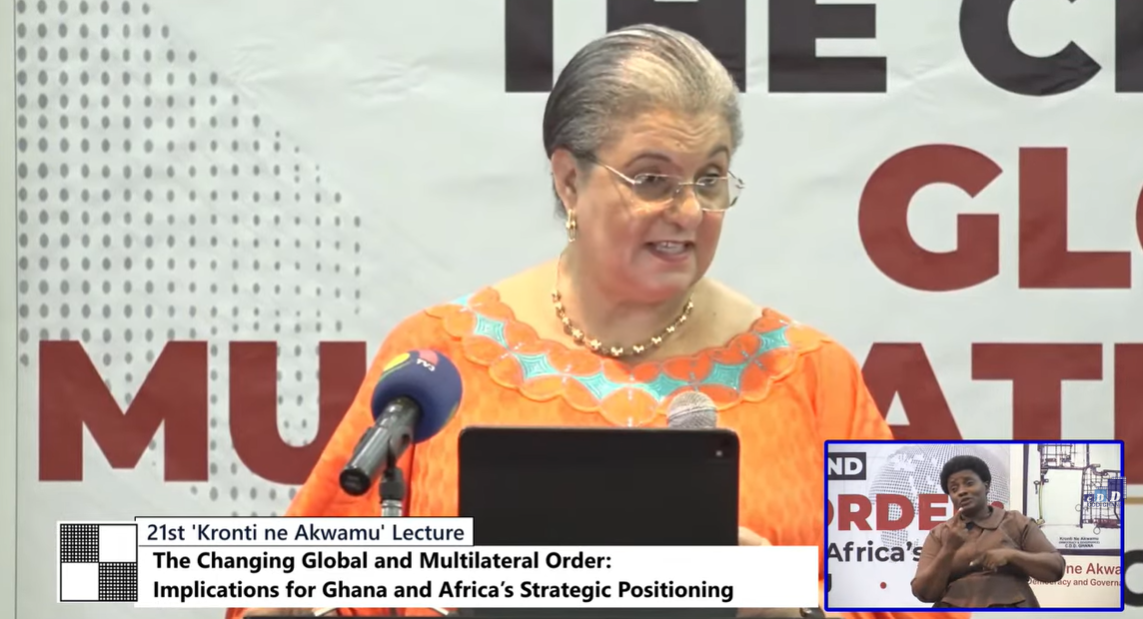
United Nations Special Representative Hannah Tetteh has urged African countries to strengthen cooperation and collective action as rising global competition creates new vulnerabilities for smaller economies.
She warned that the weakening of multilateral institutions and the growing dominance of bilateral agreements could expose developing countries to greater economic and security risks.
Speaking at the 21st Kronti ne Akwamu Public Lecture on the theme “The changing global and multilateral-based order: Implications for Ghana and Africa’s strategic positioning,” Mrs Tetteh said the changing international environment requires Africa to rethink how it engages with global powers.
She said where bilateral debt arrangements and infrastructure investments increase dependence on sovereign creditors, weaker states could find themselves with limited room to protect their interests.
According to her, power in the modern world is increasingly shaped by a country’s ability to build and control technology, industrial systems, logistics networks and security capabilities.
“The room for manoeuvre that a state has depends to a large extent on the strength of its economy, its productive capacities, its capacity and resources to defend its interests, and the extent to which it has been able to build a level of resilience to internal and external shocks,” she said.
Mrs Tetteh said the decline of multilateralism has resulted in greater emphasis on bilateral partnerships, creating a closer link between national security, economic development and geopolitics.
She referenced comments by Canadian Prime Minister Mark Carney, who described the current global situation as a “rupture” in the world order, warning that great power competition was increasingly shaping international relations.
According to Mrs Tetteh, such a reality risks creating a world where stronger states are able to impose their interests while weaker nations are pressured to accommodate them in the hope of avoiding conflict.
She said Africa must carefully consider how it builds alliances and shapes its interventions to determine its relevance in the emerging global system.
DISCLAIMER: The Views, Comments, Opinions, Contributions and Statements made by Readers and Contributors on this platform do not necessarily represent the views or policy of Multimedia Group Limited.
DISCLAIMER: The Views, Comments, Opinions, Contributions and Statements made by Readers and Contributors on this platform do not necessarily represent the views or policy of Multimedia Group Limited.
Source link