
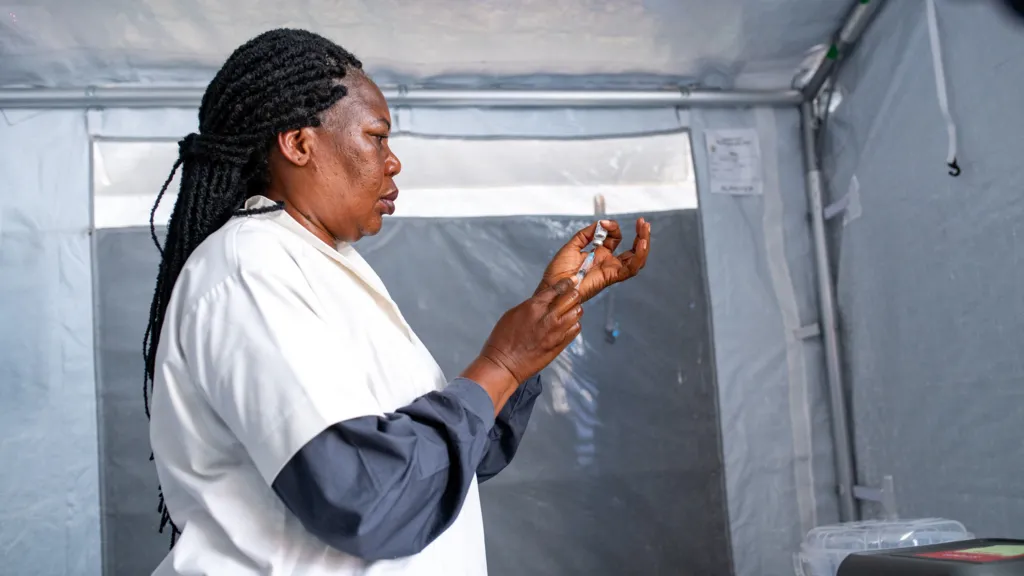
There are currently no approved vaccines or treatments for the Bundibugyo species of Ebola but some have been trialed.
Kenya has confirmed its first case of Ebola – a Kenyan citizen who has been living in the Democratic Republic of Congo for the past seven years.
Health Minister Aden Duale said the patient, who fell ill a month ago and was treated in several hospitals in DR Congo, died days after arriving in Nairobi.
Duale said the patient boarded a flight on Saturday and underwent normal public screening at the main airport in Nairobi before he was transferred by a relative to a hospital in the city.
More than 4,000 people have died from Ebola in DR Congo this year, in what is the second most deadly known outbreak of the disease.
Shortly after DR Congo declared an outbreak of Ebola in May, it was also reported in Uganda, where two people have died. However, the World Health Organisation (WHO) declared the country free of the disease in August.
Since then, all cases of the disease have been declared in the DR Congo.
The current outbreak has been caused by the Bundibugyo species of Ebola, which is relatively rare, with no known vaccine.
Duale confirmed that the Kenyan national had tested positive for the Bundibugyo species.
According to the minister, the patient first travelled by road from DR Congo to the Ugandan capital, Kampala, where he boarded a flight to Nairobi.
Duale said that after being taken to the Nairobi Hospital, the patient was transferred to an isolation facility which was built during the COVID-19 pandemic.
It was there that the patient “developed fever, chills, intense fatigue and weakness, painful swallowing, muscle pain and bleeding under the skin”.
“Doctors suspected a viral haemorrhagic fever based on his symptoms and travel history and collected samples for testing. The sample tested positive for Ebola Bundibugyo virus,” Duale said.
The patient died at 23:30 (20:30 GMT) on Monday, and his burial is planned for later on Tuesday in line with public health safety protocols.
At least 28 contacts, including family members and healthcare workers, have been identified, while health authorities are tracing a further 23 passengers and four crew members who travelled on the same flight.
So far, WHO has recorded 4,082 deaths out of 8,463 cases since the emergence of the Bundibugyo species of the virus.
There are currently no approved vaccines or treatments for the species, which is highly infectious.
DISCLAIMER: The Views, Comments, Opinions, Contributions and Statements made by Readers and Contributors on this platform do not necessarily represent the views or policy of Multimedia Group Limited.
DISCLAIMER: The Views, Comments, Opinions, Contributions and Statements made by Readers and Contributors on this platform do not necessarily represent the views or policy of Multimedia Group Limited.
Source link