
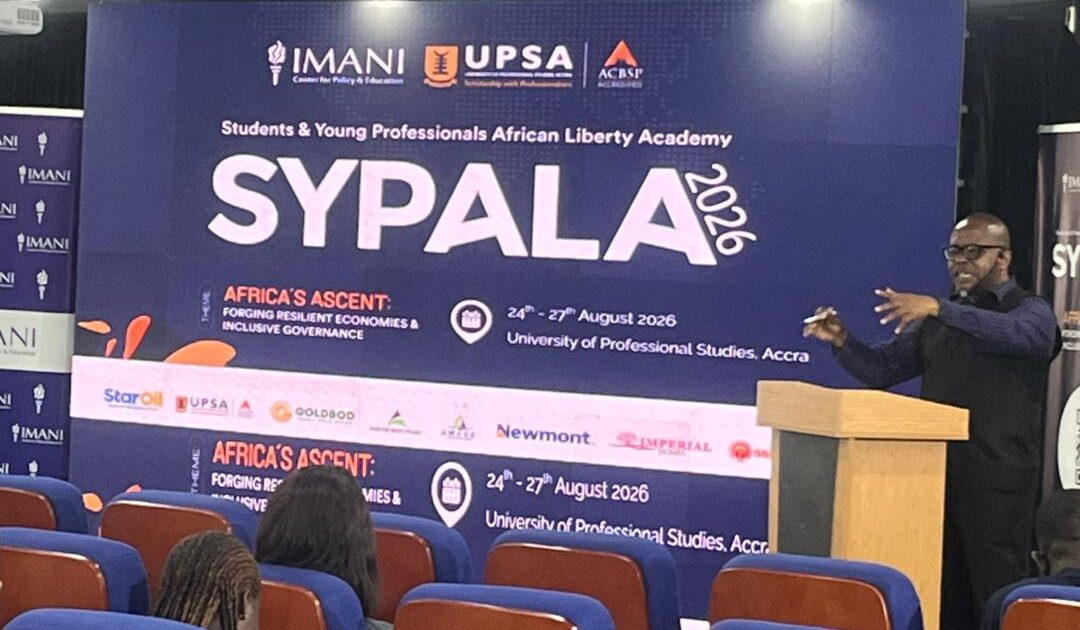
Senior Fellow at the IMANI Centre for Policy and Education, Ato Coleman, has called for a shift in how leadership and public policy are approached in Africa, arguing that technical competence alone cannot deliver sustainable and inclusive development.
He said effective leadership must be rooted in personal values, emotional intelligence, stakeholder engagement and disciplined execution.
Speaking at SYPALA 2026 on the topic “What are the leadership, skills and policy priorities needed to position Africa for inclusive and resilient growth,” Mr Coleman said leaders must first develop a strong understanding of the values that guide their decisions before attempting to influence others or implement public policies.
“My definition is not on Google. All the definitions you see here are definitions from 32 years of experience. So they come from my stomach, head, and my mind,” he said.
Mr Coleman defined a leader as someone who lives by their deepest personal values and uses those values to build a compelling case for others to follow.
He challenged participants to examine their own values, warning that occupying a leadership position does not necessarily mean an individual has a clear set of principles guiding their decisions.
Lessons from Sierra Leone’s Ebola response
Mr Coleman cited Sierra Leone’s response to the 2014–2016 Ebola outbreak as an example of what he described as Ubuntu leadership—a model based on collective responsibility, community participation and shared purpose.
He said the outbreak initially exposed confusion and weaknesses in Sierra Leone’s health system, which had already been severely affected by years of civil war.
However, the country eventually mobilised a broad coalition involving traditional leaders, faith-based organisations, youth groups, political leaders, development partners and international institutions.
He said community structures, including traditional and faith leaders, played important roles in social mobilisation, surveillance, contact tracing and enforcing public-health measures.
Political leadership also extended beyond party lines, with then-President Ernest Bai Koroma engaging opposition figures and assigning them constituencies in which they could support behavioural change efforts.
Youth groups, Mr Coleman said, also helped develop technology-driven feedback mechanisms that enabled authorities to identify emerging challenges and respond in real time.
At the regional and international levels, Sierra Leone worked with institutions including the Economic Community of West African States, the African Union and the World Health Organization.
Mr Coleman particularly credited former Ghanaian President John Mahama and former Senegalese President Macky Sall with helping facilitate a humanitarian corridor during the crisis.
He said the experience demonstrated that effective crisis management required leadership that could bring different groups together around a common objective.
From policy design to execution
Mr Coleman said effective public policy should follow a deliberate process beginning with an understanding of the environment in which a policy would operate.
This, he said, involves recognising the broader context, identifying stakeholder outcomes, determining the value each stakeholder can realistically derive, testing proposals against evidence, prioritising recommendations and developing an implementation plan.
He stressed that good intentions alone were insufficient.
“Even the most well-meaning policy fails” without disciplined execution, he argued, urging policymakers to pay greater attention to change management, accountability and measurable outcomes.
Six leadership priorities
Mr Coleman identified six broad principles he believes should guide African leadership and public policy.
These include values-based leadership rooted in morality and Ubuntu, stronger organisational design and execution, emotional intelligence, accountability and an emphasis on measurable impact.
He also called for a fundamental change in how African leaders view young people.
Rather than treating the continent’s youthful population as a potential demographic crisis, he said leaders should see young people as a resource that can generate innovation, energy and productivity when properly supported.
He urged leaders to create inclusive spaces by bringing together diverse voices, connecting stakeholders and ensuring that communities have meaningful opportunities to contribute to policy decisions.
According to Mr Coleman, the combination of values-driven leadership, inclusive participation and disciplined execution can help African countries mobilise resources, build partnerships and develop policies capable of delivering sustainable and resilient growth.
DISCLAIMER: The Views, Comments, Opinions, Contributions and Statements made by Readers and Contributors on this platform do not necessarily represent the views or policy of Multimedia Group Limited.
DISCLAIMER: The Views, Comments, Opinions, Contributions and Statements made by Readers and Contributors on this platform do not necessarily represent the views or policy of Multimedia Group Limited.
Source link