
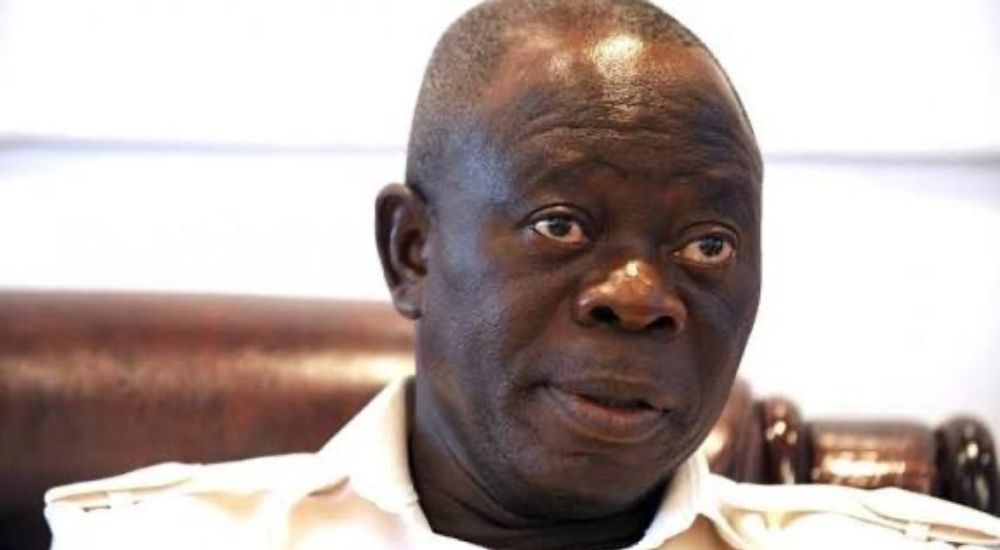
Senator representing Edo North, Adams Oshiomhole, on Tuesday defended his call for the nationalisation of MTN and other South African companies operating in Nigeria, insisting that Nigerian lives must take precedence over foreign investment amid renewed xenophobic attacks in South Africa.
Oshiomhole made the remarks on Tuesday during an interview on Arise News, where he argued that Nigeria should take stronger economic action against South African interests in response to repeated attacks on Nigerians abroad.
“I am aware that MTN is quoted, and therefore Nigerian shareholders can hold on, but we take away the South African rights,” he said.
He added that, in his view, Nigeria should consider restructuring ownership of affected firms to ensure local control.
“And because of the issue, I’m not sure of the legal status, that’s why I say you nationalise, and then you reprivatise it so that Nigerians can take it over, and the profit they are taking out of Nigeria will be retained here. There will be no South African share in it.”
The senator also referenced other foreign financial institutions operating in the country, insisting that similar action could apply to them. Oshiomhole linked his position to what he described as persistent attacks on Nigerians in South Africa, arguing that economic pressure was necessary to force accountability.
He also claimed that South African President Cyril Ramaphosa only publicly condemned attacks on foreigners after Nigeria applied diplomatic and economic pressure, though he did not provide evidence for the claim.
During the interview, Oshiomhole defended his position against concerns that such proposals could discourage foreign investment, arguing that the protection of lives should take precedence over economic considerations.
“If anything leads to the death of Nigeria, what is the value of wealth to the dead? We don’t want investors who invest at the expense of human blood. Even in my poverty, I value my life, ” he said.
Pressed on concerns that nationalisation could scare investors, he maintained that the moral question was central.
“Is human economy, weight, or foreign investor, foreign dollar more important than the life of a Nigerian?” he asked.
Oshiomhole said repeated killings of Nigerians in South Africa had gone without accountability.
“When a country, for the first time, kills Nigerians, they got away with it. Second time, they riot, they kill Nigerians, they got away with it. Third time, they kill Nigerians, they got away with it,” he said.
He also referenced past diplomatic engagements, saying commitments had not stopped the attacks.
“Under Buhari, there was an agreement. They broke it. They are killing Nigerians. Nobody is in prison for murder, extrajudicial murder,” he said.
He questioned the prioritisation of foreign investment over human lives.
“If you are a slave of wealth, if you are a slave of a foreign investor, even if that investor is blood-soaked… what is money to the dead?” he asked.
He added that Nigeria should not continue to absorb losses while its citizens remain exposed abroad.
South Africa has in recent weeks witnessed renewed protests and attacks targeting foreign nationals in parts of Durban, Cape Town, East London and KwaZulu-Natal.
President Cyril Ramaphosa has condemned the violence, describing the perpetrators as opportunists exploiting socio-economic grievances.
“These are the acts of opportunists who are exploiting the legitimate grievances, particularly those of the poor, under the false guise of ‘community activism,’” he said.
In Nigeria, the Nigerians in Diaspora Commission (NiDCOM) has urged citizens in South Africa to stay alert and avoid confrontation, while confirming that the Nigerian Consulate in Johannesburg is engaging local authorities to ensure safety.
NiDCOM also said the Minister of State for Foreign Affairs is in talks with her South African counterpart over the situation.
The comments add fresh intensity to an already sensitive diplomatic debate over how Nigeria should respond to repeated attacks on its citizens while balancing foreign investment relations.
DISCLAIMER: The Views, Comments, Opinions, Contributions and Statements made by Readers and Contributors on this platform do not necessarily represent the views or policy of Multimedia Group Limited.
DISCLAIMER: The Views, Comments, Opinions, Contributions and Statements made by Readers and Contributors on this platform do not necessarily represent the views or policy of Multimedia Group Limited.
Source link