
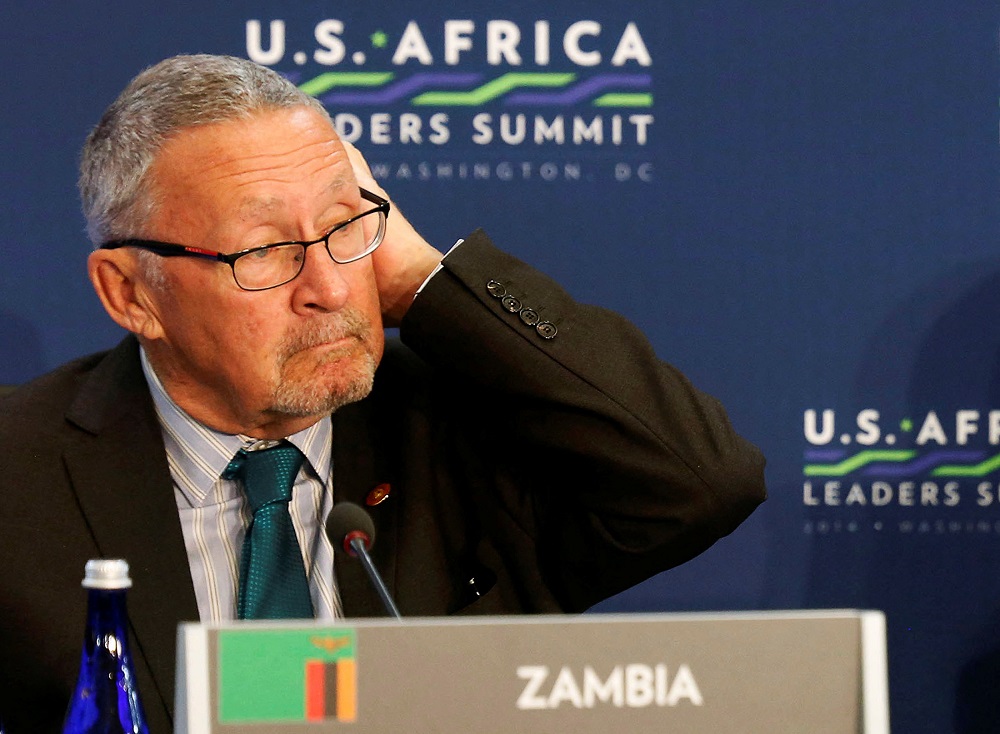
Zambia is mourning the death of former Vice-President and acting President Guy Scott, the country’s only white holder of either office, who has died at his farm in Lusaka at the age of 82.
President Hakainde Hichilema has accorded Mr Scott a state funeral in recognition of his service to the nation.
Mr Scott, a Zambian citizen of British descent, served as Vice-President from 23 September 2011 until 28 October 2014 under President Michael Sata. Following Mr Sata’s death in office, he assumed the role of acting President, serving from 28 October 2014 to 25 January 2015, when President Edgar Lungu was sworn into office.
The Zambian government announced his death in a social media post, while family members disclosed that he had been living with Parkinson’s disease and dementia.
Mr Scott occupies a unique place in African political history as the continent’s only white head of state in the two decades following the end of apartheid in South Africa.
From colonial-era Zambia to national leadership
Born on 1 June 1944 in Livingstone, near Victoria Falls, Mr Scott grew up during the final years of British colonial rule in what was then Northern Rhodesia.
Although born into a family of British descent, he chose to remain in Zambia following the country’s independence in 1964, dedicating his life to the nation of his birth.
Distinguished career in agriculture and politics
A graduate of the University of Cambridge with a background in economics, Mr Scott initially built a successful career in agriculture through Walkover Estates, a farming enterprise that exported fresh produce to supermarkets in the United Kingdom.
He entered active politics after the end of President Kenneth Kaunda’s administration in 1991, serving first as Minister for Agriculture before becoming a Member of Parliament.
In 1992, he earned widespread recognition for helping avert a national food crisis by overseeing emergency maize imports during a severe regional drought.
His political rise was closely linked to his long-standing alliance with President Michael Sata, with whom he campaigned extensively across Zambia. Together, they championed policies aimed at strengthening Zambia’s control over its copper-rich economy and reducing foreign influence.
A unique political journey
Throughout his public life, Mr Scott frequently challenged perceptions about race and national identity in post-colonial Africa.
He once remarked: “I may be white on the outside, but my blood is Black.”
He often spoke of the surprise many people expressed at seeing a white Zambian occupying one of the country’s highest political offices.
Following President Sata’s death in London in October 2014, Mr Scott became acting President for the constitutionally mandated 90-day transitional period.
His appointment sparked political debate, with opponents arguing that his family background made him ineligible to contest the presidency under Zambia’s Constitution, which required presidential candidates to have parents who were Zambian by birth.
During his brief tenure, he faced significant political tensions, including a dispute involving then Defence Minister Edgar Lungu, who later succeeded him as President after the 2015 election.
Mr Scott ultimately did not contest that election because of the constitutional eligibility requirements.
Scholar and public servant
Beyond politics, Mr Scott was recognised for his academic accomplishments. He earned a doctorate in cognitive sciences in 1986 and also pursued research in robotics at the University of Oxford.
In his 2019 memoir, Adventures in Zambian Politics: A Story in Black and White, he recounted the humour that often characterised his relationship with President Sata.
According to Mr Scott, shortly before appointing him Vice-President, Mr Sata joked:
“You, white man, late as usual, what would you be if you were not white? I think you would be dancing for coins outside the post office.”
Mr Scott replied: “Perhaps I would be president, sir.”
A few years later, following President Sata’s death, he fulfilled that prediction by becoming Zambia’s acting President.
Enduring legacy
Guy Scott’s career spanned journalism, economics, agriculture, academia and politics, reflecting a life devoted to public service and national development.
His unique place in Zambia’s history, coupled with his commitment to the country despite his British ancestry, leaves a legacy that transcends race and illustrates the complexities of identity, leadership and nation-building in post-colonial Africa.
DISCLAIMER: The Views, Comments, Opinions, Contributions and Statements made by Readers and Contributors on this platform do not necessarily represent the views or policy of Multimedia Group Limited.
DISCLAIMER: The Views, Comments, Opinions, Contributions and Statements made by Readers and Contributors on this platform do not necessarily represent the views or policy of Multimedia Group Limited.